Building something and living with it are different things. Here is what three months of actually using Onward has shown me, including the parts I never open.
Darren, who built Onward · 6 min read
I have CML and I built Onward because I wanted it. This is my own experience of using it, not advice, and not a claim about what it will do for anyone else.
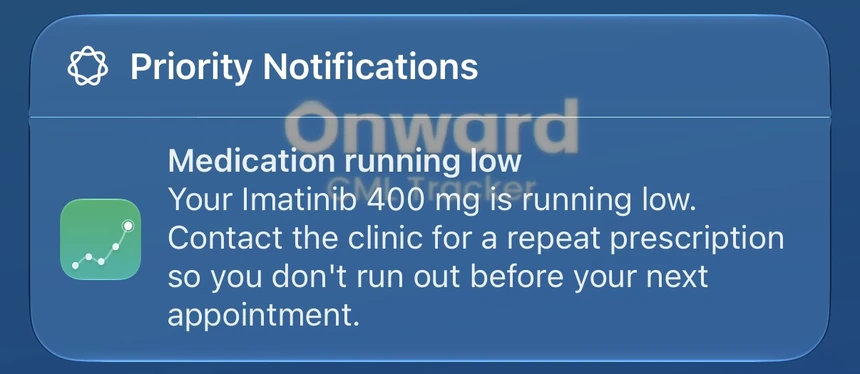
It noticed I was going to run out
Two weeks before I would have run out of imatinib, my phone told me.
When I checked, I was going to be one tablet short of reaching my next appointment. One. Not a catastrophe, and I would probably have noticed eventually, but probably is doing a lot of work in that sentence. The version where I notice on a Friday evening is a considerably worse weekend.
This is the feature I am most quietly pleased with, because it is doing arithmetic nobody wants to do. It knows your dose, it knows how many tablets you said you had, and it knows when your next appointment is. Running those three numbers together is trivial for a computer and genuinely annoying for a person on a Tuesday.
It spotted a temperature before I did
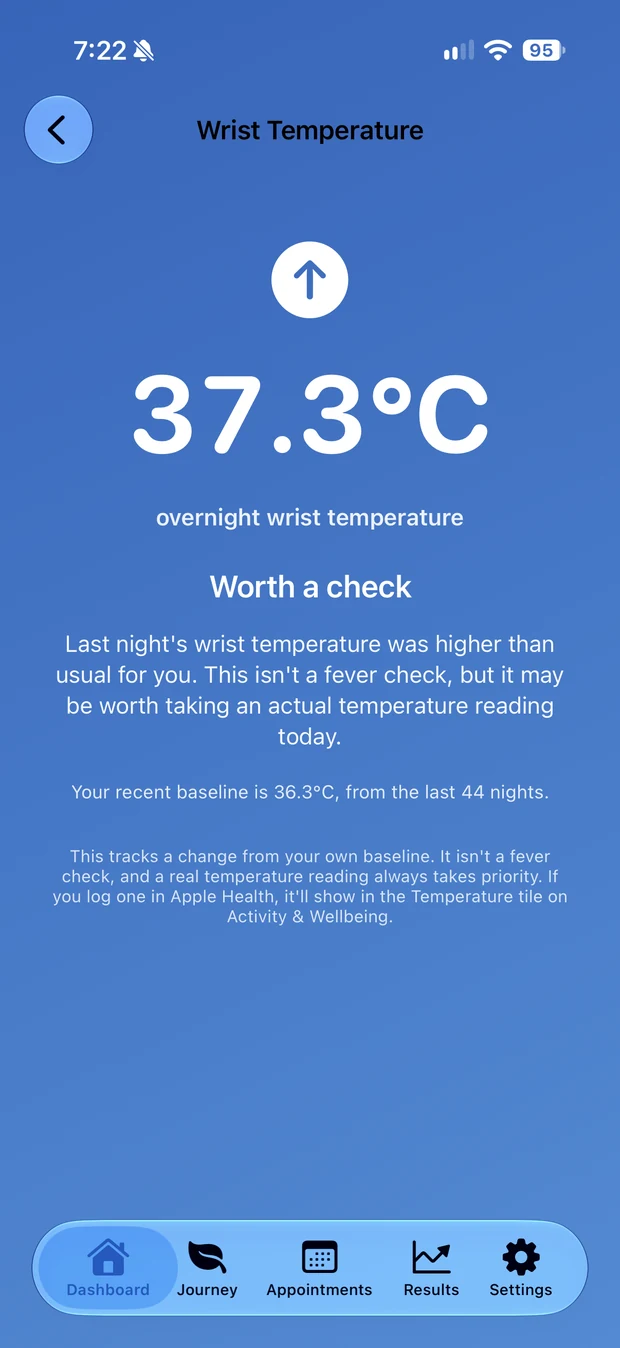
The night after my flu jab, my wrist temperature went up while I was asleep. I did not feel anything. I slept fine.
The next morning it was on the dashboard.
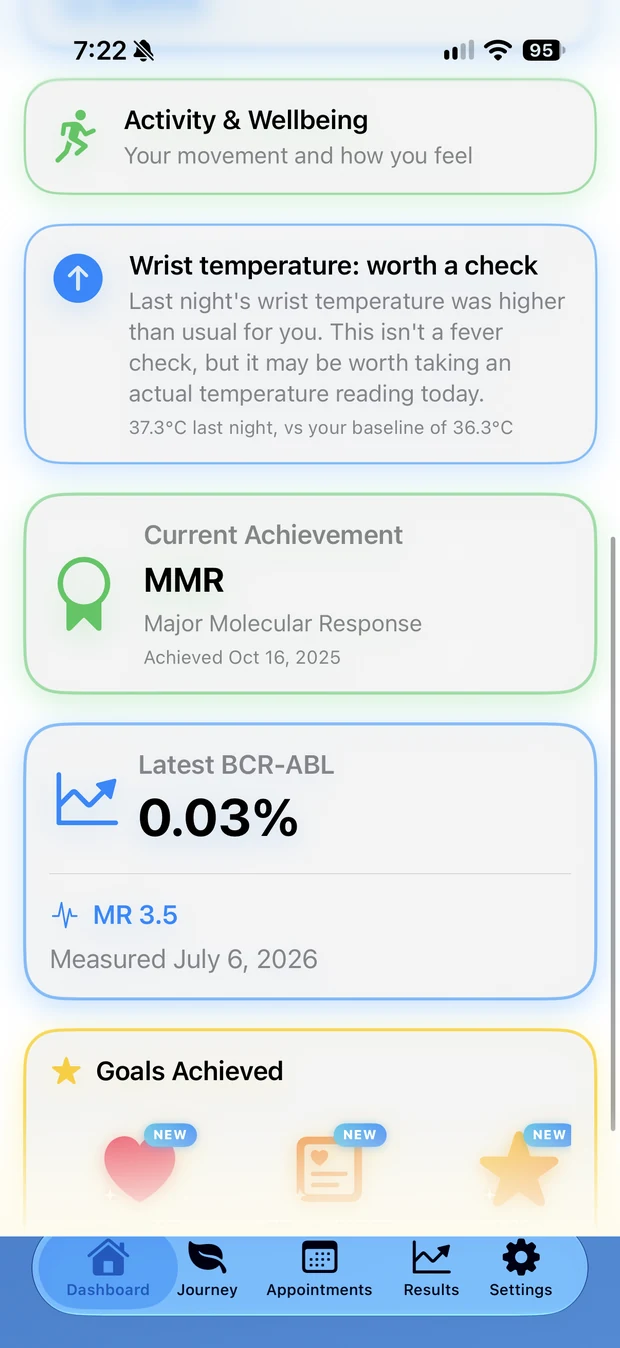
37.3°C overnight, against my own baseline of 36.3°C
By the time I took a proper reading with a thermometer I was back to normal. Which is the honest outcome, and I think it matters more than a dramatic one would.
The week after, I had my shingles jab. That night went higher and I felt rough enough to notice on my own. I did not need an app to tell me about that one.
The flu jab I would have slept straight through and never known about. It was nothing, as it turned out. But "it was nothing" is a conclusion you can only reach if you knew about it in the first place.
It is careful about what it claims. It says plainly that this is not a fever check, that it is comparing against your own recent baseline, and that a real thermometer reading always takes priority. It suggests taking one. It does not tell you that you have a temperature, because it does not know that, and a wrist is not a thermometer.
What I actually open it for
Not the thing I expected. I open it to log how I have been.
And the way I do that has changed completely. While I was testing, I logged everything every day, because I needed to know it all worked. Now I only open it when there is something to log. Nausea one day, a headache another, how bad it was. The rest I leave blank.
I do not have to record that I did not have the other things. Not logging something is just not logging it.
That turned out to matter more than any feature. An app you have to feed every day becomes another thing CML asks of you.
It is also why every symptom is a toggle you turn on or off. Fluid retention is in the list and I have never had it, so it is not in mine. Someone else will have it every week and will want it there. Neither of us should have to scroll past the other's.
The parts I never use
I barely look at the activity section. I am a runner, and I built it, and I still do not open it.
But it is not pointless, because it feeds the reports. When I hand something to my care team it can show how active I have been, which is a fair question and not one I would answer accurately from memory.
That is roughly my test for whether something belongs in the app: it does not have to be something you look at, but it has to be doing something for you.
The chart is the thing people react to
The app I used before this one showed my results as numbers in a list. Onward draws them.
Being able to show someone where I was at diagnosis and where I am now, on one line, is a genuine moment every time. It lands in a way that reading out two percentages never does, and it has done more to explain CML to my family than anything I have said.
What building it taught me
I had always assumed this was medication for life. That was simply the thing I believed, and nobody had said otherwise.
Then I started building the treatment-free remission part, and had to actually read about it properly. Finding out that stopping is a real possibility for some people, under the right circumstances and a long way down the line, was an eye-opener.
It is why the app flips when you get there. Daily dose tracking stops mattering, and it starts watching your results from the other direction instead.
I would not know any of that if I had not built it. Which is a strange thing to say about your own illness, and probably says something about how much of this you are left to find out for yourself.
The appointment that went differently
Last week my consultant asked how things had been.
Normally that question gets "fine", because that is what you can honestly produce on the spot. Three months blur. You are not going to remember a headache in July while sitting in a chair in October.
This time I said: hang on, I can tell you.
I had the prep sheet with me, so I read him the lot. Every side effect I had logged, and the dates. He was surprised, and we went through them one at a time with what he thought about each one. There were not many, and none of them were dramatic.
He wrote to my GP asking for some follow-up tests so he could review the findings.
If I had just said "I'm fine", none of that would have happened.
That is the part I did not anticipate when I was building it. I thought I was making something to help me remember. It turned out to be something that changed what my team could do, because they were working from what actually happened rather than what I could recall under pressure.
The Journey is still the best part
The appointments and the results are what the app is for. The Journey is why I keep it.
It holds the clinic visits and the numbers, but it also holds the real moments. The first long walk. A weekend away. The ordinary good days that have nothing to do with any of this.
That is the part people forget about a diagnosis. Yes, there are a lot of appointments and a lot of new words to learn. But in between there are real things happening, and for a moment you forget you are living with cancer.
Those are worth keeping too.
Onward
A calm, private place to follow your own CML journey. Free, with no accounts and no ads, and your data stays on your device.
Written by Darren, who has CML and built Onward. A personal account, not medical advice. Onward is a record-keeping tool and not a medical device; it does not diagnose anything, and a wrist temperature reading is not a fever check. Always follow the guidance of your own care team.
 Darren, who built Onward · 6 min read